
“There are three kinds of lies: Lies, Damned lies, and Statistics.” – Mark Twain
A bold and provocative introduction to what promises to be a groundbreaking article, set to transform our understanding of access to and interpretation of data metrics and analytics in relation to goalkeeping. Before proceeding with this article, I want to clarify that I do not claim to be a data scientist, nor am I attempting to undermine the importance and value of data metrics and analytics. The sole purpose of this article is to highlight the misinterpretation of data analytics associated with certain terminologies in the context of goalkeeping database metrics.
When sets or groups of data metrics are collected for analysis, the ability to effectively tell a story based on that data becomes crucial in conveying a clear and accurate message. It’s important to recognize that different interpretations can be derived from the same data. However, if the conclusions drawn from analyzing data related to a particular topic, terminology, etc, are incomplete or unclear, doesn’t that create an opportunity for misinformation to emerge and influence understanding? In the new age of technological advancement, where stakeholders are the driving force in its implementation for bigger profit margins, it has become even more important to be as thorough and astute in creating conclusive findings of intrinsic value. It is for this reason that the roles of technical analysts, when attempting interpretations of data metrics on a specific subject, require them to acquire prior knowledge of the subject matter. The first position on a football/soccer pitch (number 1 aka Goalkeeper) is the most important position on the pitch and requires a completely different type of skillset abilities for the role to be fulfilled, in comparison to outfield players. Attempting to interpret quantitative data metrics to correlate with qualitative attributes on specific goalkeeping skillsets can be challenging unless one fully understands the complexities and nuances involved in the art of goalkeeping. It’s evident that data metrics like pass completion, cross attempts, saves, goals conceded, penalty attempts, distribution, games played, percentile vs. goalkeepers, etc, and their subdivisions for detailed data analytics are, by and large, relied upon for interpretations, the more recent terminologies like PSxG that happens to be the new metric of measuring goalkeeping abilities are purely subjective in its interpretation and implementation, and as technical analysis continues to evolve, the narratives of the Status quo would follow suit.
The terminology used in the technical analysis of goalkeepers’ shot-stopping abilities is crucial for stakeholders such as club academies, scouts, investors, football clubs, agents, and agencies. They rely on the interpretation of such datasets related to the terminologies for strategic planning and talent acquisition. However, the question remains: Are the interpretations of these terms clear and accurate in relation to the data metrics provided? For instance, PSxG is broken down into PSxG/SoT and PSxG+/-, but after analyzing a set of data and attempting to align these metrics with their intended narrative, I noticed discrepancies between the data and how the terms are interpreted. I feel compelled to share my thoughts on this issue because addressing these inconsistencies could reshape how we interpret data metrics by emphasizing the need to uncover the true value of these two key terms.
PSxG/SoT
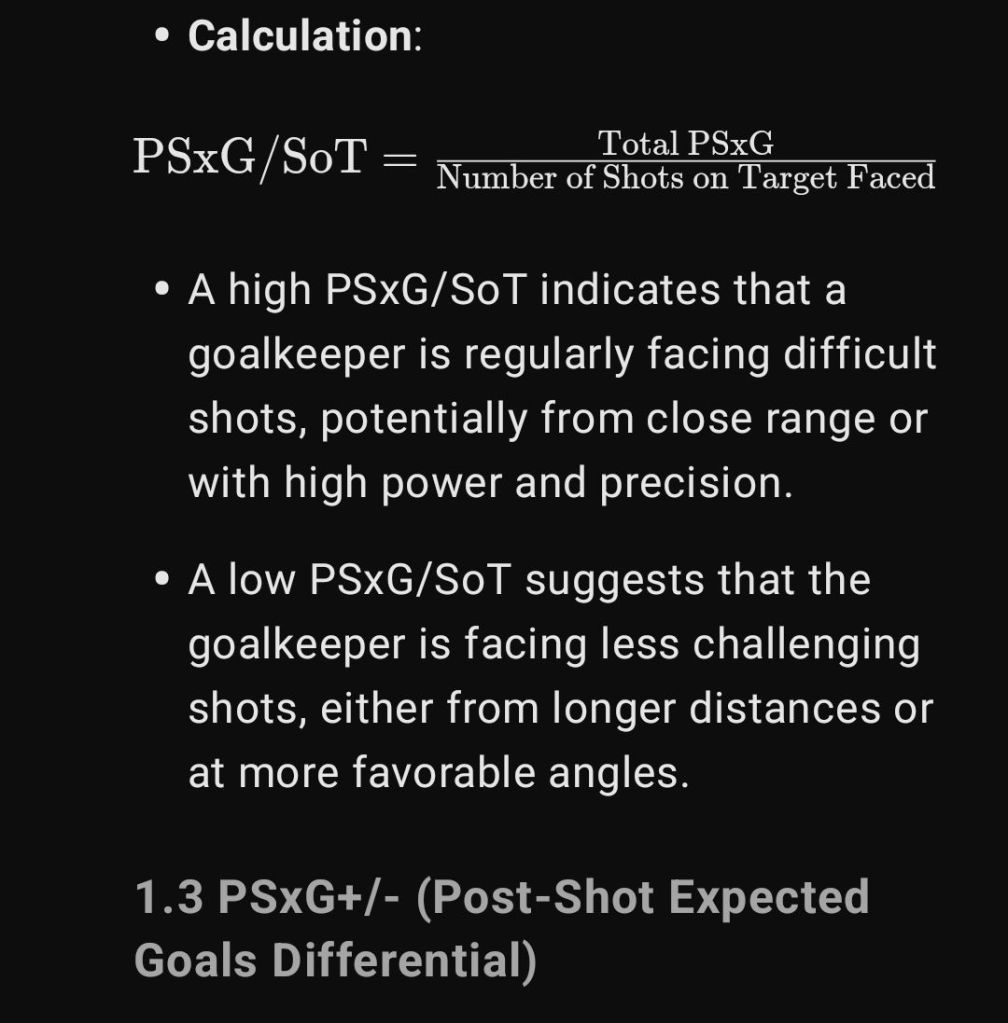
After shifting through the various data providers, data companies, and AI, the most transparent explanation of PSxG/SoT is that it calculates the average quality of shots that a goalkeeper faces when they are on target. It tells us how difficult, on average, each shot on target is in terms of its likelihood of becoming a goal. Below is an illustration of the formula
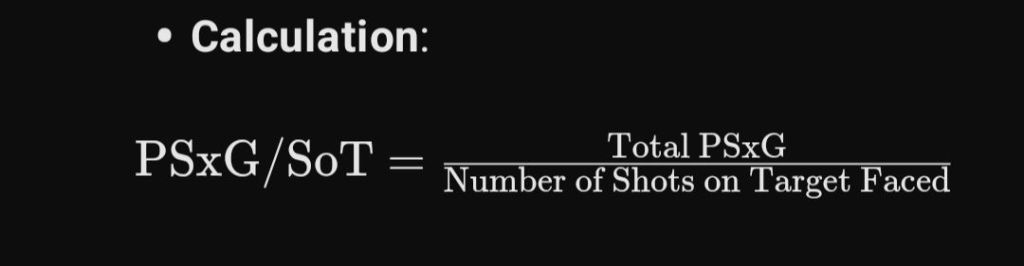
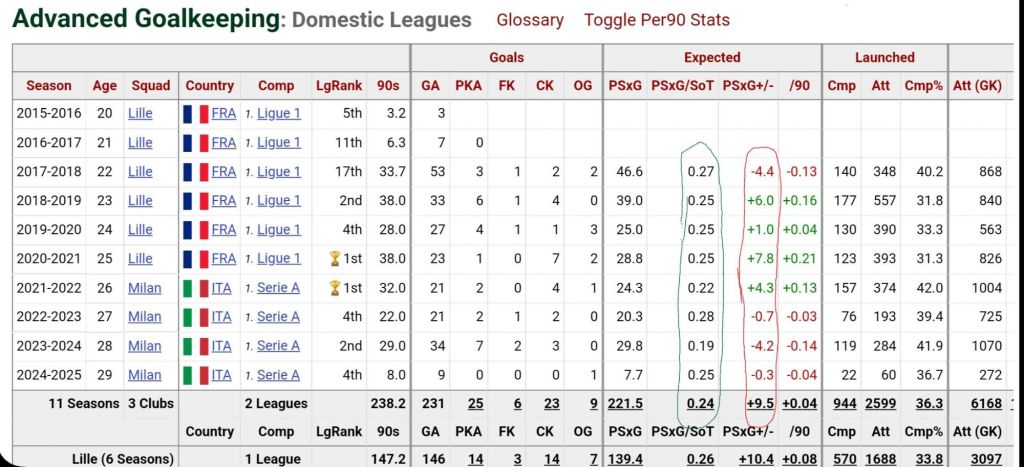
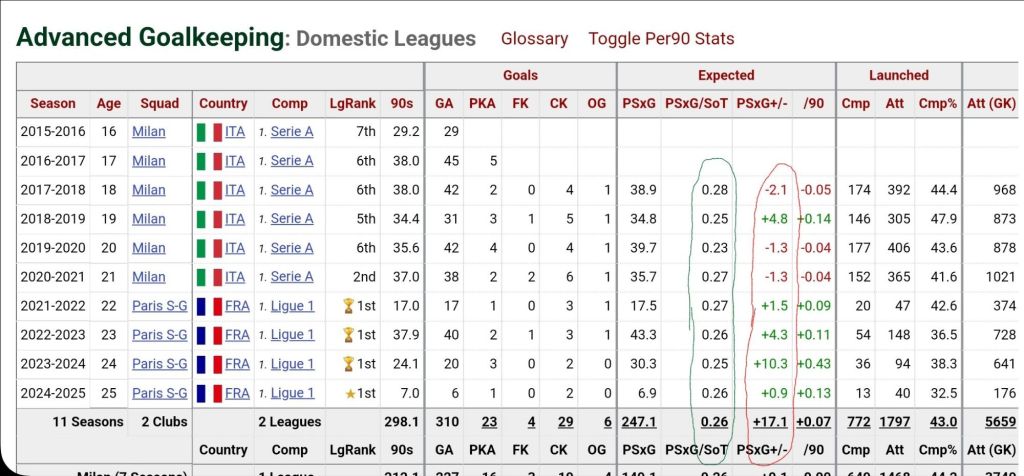
A high PSxG/SoT indicates that a goalkeeper is regularly facing difficult shots, potentially from close range or with high power and precision. Here’s an illustration from FBREF of the data metrics of Mike Maignan of AC Millan highlighted in green..
A low PSxG/SoT suggests that the goalkeeper is facing less challenging shots, either from longer distances or at more favourable angles.
Now, please keep in mind the definition of these terminologies as we will later attempt to establish its correlation with goalkeeping skillsets.
PSxG+/- (Post-Shot Expected Goals Differential)
According to my research, PSxG+/- measures the difference between the total PSxG of shots faced and the actual goals conceded by the goalkeeper. This metric evaluates a goalkeeper’s shot-stopping performance relative to the difficulty of the shots they faced. This measure also has a calculative formula highlighted below: –
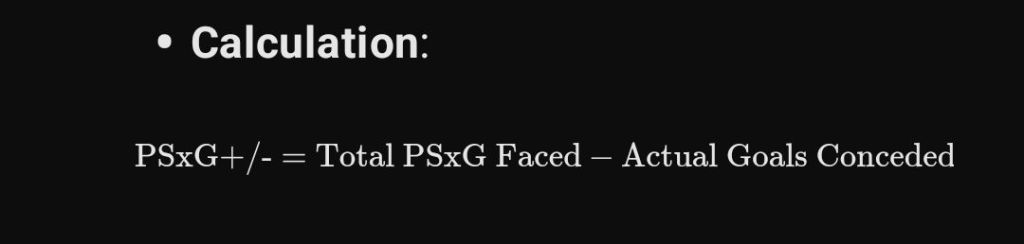
Positive PSxG+/-: The goalkeeper has saved more goals than expected, indicating exceptional shot-stopping ability. An example is an illustration of Gianluigi Donnarumma of Paris Saint Germain statistics highlighted circled in red..
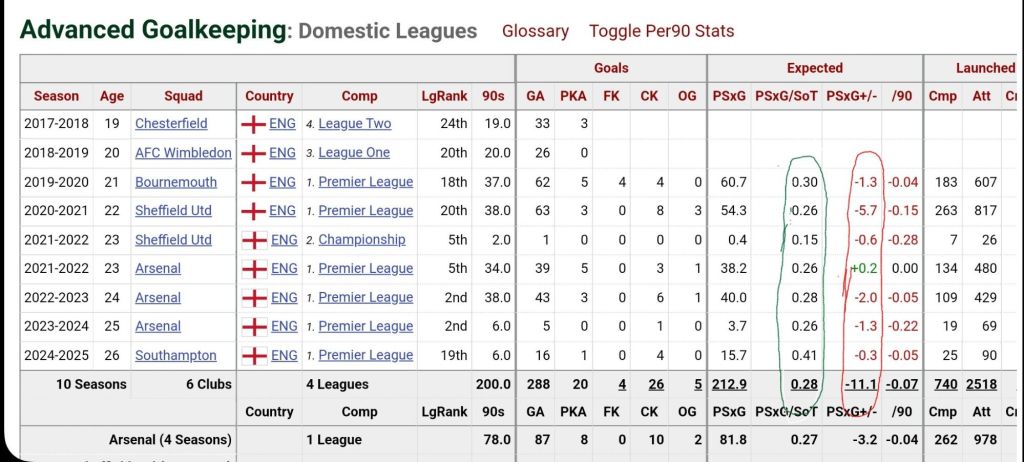
Negative PSxG+/-: The goalkeeper has conceded more goals than expected, suggesting that they are underperforming relative to the quality of shots faced. The illustration below indicates the statistics of Aaron Ramsey of Southampton FC highlighted in the red circle..
Now, having extracted the data metrics relating to each terminology, we are going to investigate the interpretations of these data metrics through the medium of a goalkeeper performance analyst, in comparison to the official narrative that stakeholders adhere to.
The Perception of Interpretation
Post-Shot Expected Goals (PSxG) isn’t as straightforward as a concept for evaluating goalkeeping shot-stopping capabilities as it may initially seem. This metric relies heavily on factors like shooting accuracy and the variety of shots on target from outfield players (forwards, midfielders) to assess the degree of difficulty a goalkeeper faces in any given situation. A challenge with PSxG is that it tends to assume a cap or limit on a goalkeeper’s shot-stopping ability, implying that certain shot types inherently surpass the goalkeeper’s capacity to make a save. Many might subscribe to this theory, but I, for one, do not agree with this as the art of goalkeeping still is in the evolutionary process of becoming more. The dangers this ideology poses are: –
- Creates potential blindspots for goalkeeping coaches as far as performance analysis, troubleshooting, development, and improvement are concerned
- Elite and professional goalkeepers become indistinguishable, creating a false perception of value to stakeholders relative to the interpretation of data metrics
- Misrepresentation of market value of individuals due to PSxGs preliminary findings or insufficient analysis on the basis of its definition and interconnectedness to goalkeepers shot-stopping capabilities
To get a deeper understanding of the insufficient analysis attributed to these terminologies, let’s examine the data metrics highlighted above of the individual goalkeepers and correlate them with the goalkeepers’ shot-stopping capabilites.
I’ve analyzed the PSxG/SoT metrics for a substantial number of goalkeepers using data from FBref, spanning an eight-season period. The findings show that the mean averages are remarkably consistent across goalkeepers when examining differences and comparisons. In the data visualization, metrics highlighted in green reveal that these averages are nearly identical. However, these figures alone do not provide insight into the relative shot-stopping skills of the goalkeepers.
When we introduce the PSxG+/- metric, highlighted in red, the analysis becomes more revealing. For instance, Gianluigi Donnarumma’s mean PSxG/SoT over eight seasons stands at 0.26, with a PSxG+/- mean average of +17, indicating his exceptional shot-stopping ability. In contrast, Aaron Ramsdale has a slightly higher mean PSxG/SoT of 0.28 (a marginally higher level of difficulty by 0.02), but his PSxG+/- shows a significant deficit of -11.
Many would argue that this suggests a stark difference in shot-stopping proficiency between the two goalkeepers. But is this interpretation accurate? The critical question remains: Would Donnarumma consistently outperform Ramsdale if placed in Ramsdale’s circumstances (or gloves, more precisely), and vice versa? Additionally, should we consider whether factors like the quality of the league, strengths of the oppositions in said leagues faced, or PSxG variables are the real determinants of their performance? These questions become more evident when we study a large amount of case samples as we discover the data metrics do not relate to the narratives assigned to the terminologies it is meant to represent.
When we delve deeper into the analysis, the data metrics associated with goalkeeping shot-stopping performance only reveal what is happening on the field, which represents just half of the picture. The other half—what could potentially happen—remains unclear and is often lost in translation. This is largely because the collective focus has shifted from enhancing shot-stopping abilities to prioritizing other areas, such as distribution and ball possession. As previously mentioned, there is a sense within the goalkeeping community that shot-stopping skills have reached a plateau, prompting more emphasis on developing other attributes to benefit the team. I want to be clear that I fully support this evolution of the role, but we must not forget the primary duty of a goalkeeper: safeguarding the goal.
The key point I am making is that if we rely on specific data metrics to assess shot-stopping proficiency, it is crucial that these metrics are interpreted in a way that provides actionable insights. They should guide goalkeepers, coaches, and staff on the exact training and conditioning areas that need attention to elevate performance effectively. In the goalkeeping community, articles have been written about this particular topic and have also addressed the challenges PSxG faces when under deep investigation as to its accuracy and practicality. A blog post dated in 2018 by Mike Goodman of StatsBomb made a case about the usefulness of PSxG but also raised notable concerns from a paragraph in his article..
We don’t know if this data will show us that shot stopping is a clearly repeatable skill that the noise of other data has kept hidden. We don’t know if the data can show us whether different keepers have different strengths and weaknesses. Maybe there’s actually little to no difference at all when it comes to keepers stopping shots. We just don’t know yet. – Mark Goodman
Although he made a compelling case of its practicality, this particular transcript outweighs the positives due to the complexity of the terminologies’ function. Another separate article dated 14th March 2022 written by Liam Hanley from The 18.com , where he discusses extensively about the goalkeepers he was analysing in comparison to their data metrics, also talked about PSxGs’ limited interpretation as quoted ..
Advanced statistics are not a replacement for understanding a goalkeeper’s technique or decision-making, nor is it useful to appraise a keeper based on one statistic, but when various categories of advanced stats are used in tandem with a more technical understanding of a goalkeeper’s play, only then can we begin to fairly evaluate a goalkeeper’s ability.
Furthermore, he quoted an additional point of fact in his concluding article..
Yet, while soccer is accepting the computational power of the modern age, goalkeeping stats are still waiting for their Industrial Revolution. Good data is there; it is just being overlooked. Until then, the goalkeepers position will continue to be under-evaluated.
Although the ideological consensus in the data sports science and the goalkeeping community is largely adopted as far as PSxG/SoT and PSxG+/- are concerned, there are still vital questions as to the accuracy of its interpretation in relation to goalkeeper shot-stopping abilities and acts as a true representation of intrinsic value.
Conclusion
I could have easily written a full essay on this topic, but the points covered in this article are enough to highlight concerns about how we interpret data metrics. The evolution of goalkeeping relies heavily on how these metrics are understood rather than the raw data itself. As I stated earlier in the first paragraph, I am neither a data scientist nor an analyst, and I certainly don’t dismiss the value of data analytics in today’s world. It’s only natural for a curious mind to seek connections between data analysis and its interpretation to better grasp its role. Far too often, so-called experts in data science and technology across various sectors make errors in prediction and analysis, and these inaccuracies are evident in areas like finance, stock markets, and more recently, in the U.S. Presidential elections. In that case, polling data projected a strong outcome for the Democrats, yet the Republicans won decisively, defying expectations. This stresses the critical importance of correctly interpreting data.
The primary challenge in understanding these terminologies lies in the labelling itself. The term Post-Shot Expected Goals is dependent largely focused on evaluating the goal-scoring capabilities and skill levels of outfield players. However, this emphasis does not accurately reflect the metrics needed to describe a goalkeeper’s shot-stopping abilities. A more fitting term might be Post-Shot Expected Saves, but the issue adopting this terminology is that there is currently no system capable of qualifying and quantifying a nuanced formula that captures ranges attributed to shot-stopping skill sets. Additionally, intangible factors like mental well-being, belief systems, and other psychological aspects are difficult to integrate into a comprehensive data analytics framework. Having said that in the near future, this problem is guaranteed to be solved and, as a result, will recalibrate our perception of the composition of an elite goalkeepers’ intrinsic value as far as their shot-stopping capabilities are concerned.
The journey to becoming an elite goalkeeper is a continuous process of evolution enriched by various ideological and technological advancements. Some of these innovations will be invaluable, while others—especially high-tech gimmicks—might become obstacles or add little to no value. It’s essential to remember that the goalkeeper’s core mission is to keep the ball out of the net, a goal that demands highly refined, specific skill sets that are constantly under reevaluation in response to the evolution of play. Believing that today’s elite goalkeepers in the top leagues represent the peak of excellence would be a misconception, as there is always room for further growth and improvement, which ironically is required now more than ever.
You Are The Ultimate Keeper Of Your Destiny
ULTIMATE KEEPER
 KEEPERS KORNER