

The World Belongs To Those Who Let Go –
Lao Tzu
Prepare for a groundbreaking shift in goalkeeper representation at both the professional and elite levels of the game. As clubs, academies, and key stakeholders increasingly pursue forward-thinking, results-driven approaches, there’s a growing demand for methodologies that maximize return on investment for all involved—while elevating the broader football ecosystem. You might wonder, “What’s driving all this excitement?” The answer can be summed up in two powerful words: Intrinsic Value.
The intrinsic value of goalkeepers in professional football goes far beyond traditional measures of performance. Their influence on a team’s defensive organization, tactical coherence, and psychological confidence ate fundamental components in the evolutionary process. As football evolves, appreciating and amplifying this intrinsic value through technology, storytelling, and intelligent branding will be key to developing and representing the next generation of elite goalkeepers. The unique role of goalkeepers points to the intrinsic values that often outweigh their visibility in highlight video clips or traditional statistical metrics. Some of these roles are:
- Playing the last line of defence, which a mistake usually results in a goal
- Initiating play often with the first touch in the build-up play from possession.
- Controls space and time through anticipation, communication, and organisation
- Serves as the team psychological anchor. This is an important and uncompromising trait that consists of confidence and calmness.
The psychological makeup of a goalkeeper is becoming an increasingly vital component, now emerging as the key determinant of intrinsic value. This is largely because, although it can not be quantified through traditional data-driven methods, it paradoxically has a profound influence on the development of a goalkeeper’s skillset and the very data that analytics aim to interpret. Game-changing moments—such as penalty saves, one-on-one stops, aerial dominance, and precise distribution—are just a few of the many disciplines that can be quantified through visual and digital data analytics. However, an equally critical yet often overlooked aspect is the goalkeeper’s ability to maintain consistent performance across an entire season. This level of reliability brings much-needed stability to a team and represents a rare quality with immense intrinsic value—one that is not captured in highlight reels or occational evaluations.
Unlike attackers, who can afford multiple missed chances, goalkeepers operate under a zero-tolerance margin for error. Every decision they make carries elevated pressure and consequence. Maintaining emotional balance—navigating the extreme highs and lows of a match, while absorbing both the praise and criticism from fans—is essential. This psychological resilience, coupled with their ability to perform under intense scrutiny, significantly amplifies the goalkeeper’s often unseen but critical contribution to a team’s overall success. So, what are the groundbreaking methodologies required to uncover intrinsic value, one might ask? The concise—yet complex—answer lies in how we continuously revise and refine the way we consume and interpret existing data metrics, alongside the evolving expectations and outcomes defined by end-users.
Quantifying Intrinsic Value
Statsbomb, Opta, Statsperform, Catapult, and many other major sports data companies are revolutionising the protocols of data metrics consumption and its implementations. As far as goalkeeping is concerned, there’s an array of advanced data mining metrics in the form of new performance analytics and AI-driven tools, which are beginning to close the visibility gap:
- Post-Shot Expected Goals (PSxG) vs Saves
- Sweeper Actions per 90
- Save Difficulty Index
- Goal Prevention Models
- Contribution to Build-up Play Metrics
These tools, which contain sub-sections and divisions in every category, help align a goalkeeper’s intrinsic value with measurable outputs, improving how clubs, agents, and analysts evaluate their true impact. Here are some illustrations from Stathead FBref a well renowned database mining sports tech company on goalkeeper analytics;

Andre Onanas’ Scouting Report

Marc-Andre ter Stegens’ Domestic League statistic report
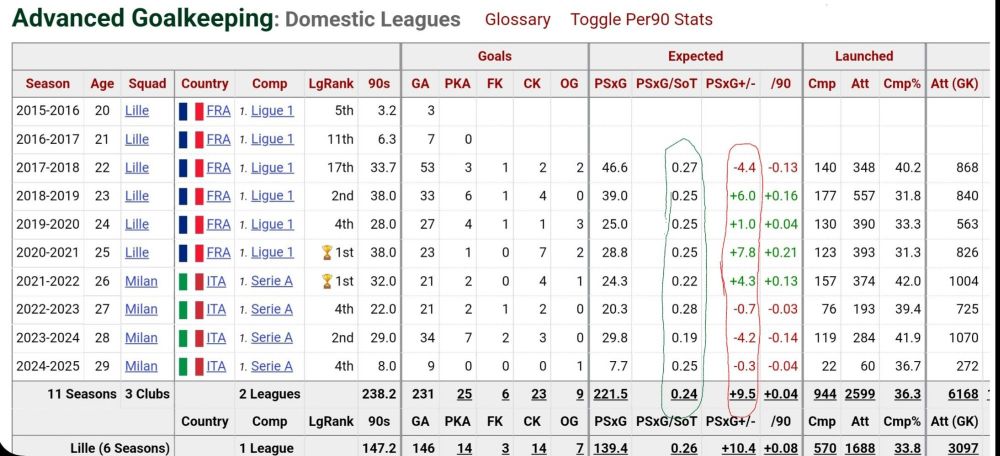
Mike Maignans’ Domestic League statistics report
These statistics represent just a subset of a broader range of data metrics, including playing time, possession, passing accuracy and type, defensive actions, goal and shot creation, as well as standard statistical indicators. While these metrics can offer valuable insights, their increasing complexity often raises questions about their practical application—especially for those working directly with goalkeepers, such as coaches and the players themselves.
The core issue lies in understanding how effectively these detailed metrics contribute to assessing the progression, evolution, and market value of goalkeepers. Many professional goalkeeper coaches may find it challenging to interpret and integrate such an expansive dataset into their training frameworks in a meaningful and actionable way. The key point is this: while these data sets are undoubtedly valuable from an informational and analytical standpoint across the wider football ecosystem, there remains a pressing need for a more robust, pragmatic, and context-specific system of data interpretation. Such a system would more accurately capture the unique development and intrinsic value of goalkeepers, ultimately reflecting the ongoing evolution of the art of goalkeeping.
Determining Intrinsic Value
As the modern game continues to evolve within a high-stakes football ecosystem, the intrinsic value of goalkeepers is increasingly defined by the specific demands of professional and elite clubs at any given time. For elite clubs in particular, the desired goalkeeper profile is often shaped not only by tactical requirements but also by a broader philosophical vision that reflects the club’s interpretation of success. The following case studies illustrate how elite clubs assess and define the type of intrinsic value that contributes to their success:
- Thibaut Courtois (Real Madrid) or Emiliano Martínez (Aston Villa FC) show that key saves at critical moments elevate a team’s results beyond what statistics alone might indicate.
- Manuel Neuer (Bayern Munich) redefined the modern goalkeeper role—showing intrinsic value through positioning, passing, sweeping behind the defence-line and psychological command.
- Alisson Becker (Liverpool FC) and Ederson Moraes (Manchester City FC) illustrate how distribution and calm under pressure can fundamentally alter a team’s playing style.
Each of these elite goalkeepers was recruited by their respective clubs based on how those clubs interpreted and prioritized intrinsic value in pursuit of success. Naturally, not every decision yields the desired outcome—as illustrated by Manchester United’s acquisition of André Onana. The club believed they were securing a top-tier shot-stopper with strong psychological presence and elite distribution skills. However, it quickly became apparent that Onana has, at best, demonstrated only one of those three critical attributes. It now seems increasingly likely that he will be transferred before the start of the 2025/2026 Premier League season. While there are other similar examples, from the standpoint of goalkeeping’s ongoing evolution, the ultimate objective remains the same: to develop the complete goalkeeper—an individual who fully embodies the varied qualities that define true intrinsic value in the modern game.
Implications for Clubs, Agents, and Stakeholders
Clubs
For professionals and elite clubs across global leagues, financial sustainability is a cornerstone of building a profitable and resilient business model. This is precisely why regulations such as the Profit and Sustainability Rules (PSR), the Financial Sustainability Regulations (FSR) and Parachute Payments (for relegated clubs) exist, to ensure clubs maintain a balanced approach to income and expenditure, particularly in player investments, thereby promoting fair competition. Within this framework, strategic investment in goalkeepers with high intrinsic value becomes crucial. The number of goals conceded can significantly influence league standings, title races, qualification for financial incentives, and even relegation battles, underscoring the goalkeeper’s impact on both sporting outcomes and financial performance.
Agents
Enhancing goalkeeper representation through advanced metrics and value narratives is a process that involves integrating advanced performance metrics with well-crafted intrinsic value narratives that can significantly enhance the representation and transfer market leverage of goalkeepers. While data analytics in football continues to evolve rapidly, goalkeeping analytics still lags behind, particularly in how data is interpreted and applied. Unlike outfield player metrics, which offer clearer frameworks for assessing quality, goalkeeping data is far more intricate and nuanced, making it challenging to determine true market value accurately.
Goalkeeping is a highly specialized role that demands a distinct analytical methodology. Traditional digital and visual databases represent only a fraction of the broader, more complex talent identification spectrum for this position. To accurately capture a goalkeeper’s intrinsic value, analytical models must account not only for statistical outputs, such as the standard deviation, mean, and median within specific skill set categories, but also for the intangible elements that influence performance and development.
By incorporating both quantitative data and qualitative insights, agents can more effectively position their goalkeeper clients in the market, leveraging these narratives to secure more favourable contract terms. Likewise, clubs can engage in transfer negotiations with greater precision and profitability, aligning valuation expectations, and optimizing deal outcomes for all parties involved.
Brands
Bringing to light the unique mental strength, technical excellence, and leadership presence of elite goalkeepers allows us to craft inspiring brand stories that ignite passion in fans and fuel the dreams of aspiring goalkeepers. This impact can only be achieved through an approach that aligns authentically with both the brand’s vision and the goalkeeper’s true character. At its core, it’s the intrinsic value that unlocks meaningful sponsorships deals and manifest a legacy, one that sets a powerful benchmark for progress and empowers the next generation of goalkeepers to believe, lead, and redefine the art of goalkeeping.
Conclusion
Modern professional goalkeeping faces a significant challenge: preserving its traditional foundations while integrating with the evolving demands of the modern game. The rapid influx of financial investment from corporate and private entities, many of which operate outside the traditional football ecosystem, alongside the rise of sports data science and technological innovation, has made it increasingly important to accurately define and measure the intrinsic value of goalkeepers. This is essential not only for protecting and preserving the art of goalkeeping but also for ensuring its organic evolution.
At the highest levels of the game, the current trajectory appears to favour a hybrid model, merging the attributes of goalkeepers with those of outfield players. However, this direction risks sidelining the continued development of core goalkeeping skill sets. This trend is particularly concerning in the women’s game, where the foundational technical aspects of goalkeeping are still in the early stages of development. Prioritising outfield-like traits over goalkeeping fundamentals may ultimately hinder the growth and mastery of the position as a specialised discipline.
Effective goalkeeping representation and career management can only be delivered by those who fully grasp the critical importance of identifying and nurturing a goalkeeper’s intrinsic value. The more you see, the more you must honour what you know.
The Final Destiny
Ultimate Keeper
 KEEPERS KORNER