
Art is an end in itself; its values are intrinsic –
Daniel Bell
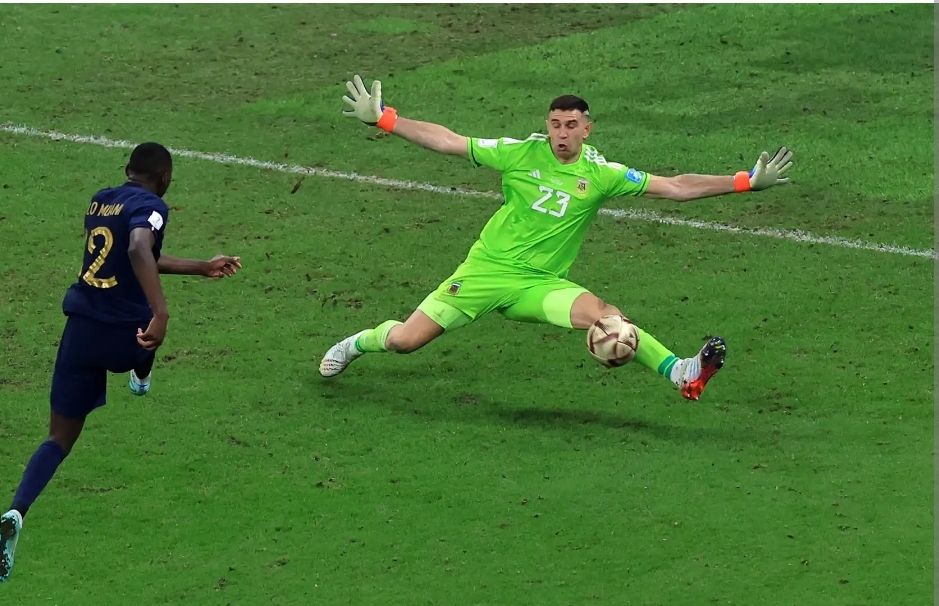
Since Emiliano Martínez’s dramatic last-gasp intervention — widely hailed as the “save of the decade” — against France in the 2022 World Cup final in Qatar, widespread attention has focused on the distinctive way he deployed his goalkeeping skillset, a moment that ultimately proved decisive in Argentina securing their third world title. The technique, now popularly referred to as the X-Block due to its complex body positioning, was executed with perfect timing at the precise moment of contact as Randal Kolo Muani pulled the trigger. Its success has reshaped perceptions around how this specific action can be applied within elite goalkeeping.
Today, the X-Block is increasingly promoted across the goalkeeping community as the ideal solution in 1 vs 1 situations — and in many cases as a core extension of modern shot-stopping methodology. However, in an era where performance is scrutinised through data metrics, statistical modelling, and intrinsic value assessment, a critical question remains: does the optimisation of this technique genuinely withstand analytical evaluation, or is its reputation driven more by narrative than measurable impact?
Pascal Zuberbühler — the former Switzerland international and current senior goalkeeping specialist at FIFA — offers a clear and structured breakdown of the X-Block technique in his FIFA Training Centre article Understanding the X-Block. He outlines the core technical demands behind executing this highly complex action, including optimal positioning, the critical six-metre engagement zone, real-time adaptation to attacking dynamics, and, above all, the importance of reading situations before committing to a decision. He also emphasises the role of targeted, educational goalkeeping coaching in ensuring the technique is applied effectively and consistently.
These insights have strongly influenced the wider goalkeeping community. Performance data now indicates a noticeable rise in both the frequency and in-play deployment of the X-Block across one-on-one scenarios. Naturally, the growing reliance on a single dominant technique — often at the expense of alternative solutions — invites important questions about balance, effectiveness, and long-term optimisation in modern shot-stopping abilities, which I am about to divulge in debate as to the level of concern (if any) from my observations.
Training Methodologies
When goalkeeping coaches design training programmes — particularly when aiming to refine a specific skillset such as the X-Block — the chosen method of application quickly becomes the central reference point. This raises a fundamental question: what is the true objective behind the desired outcome? From observing a wide range of professional goalkeeper training sessions and social media coaching content (without singling out individuals), a recurring pattern emerges. Much of the methodology appears to prioritise programmed activation of the X-Block action itself, rather than optimising when and why the technique should be deployed within realistic game situations. Numerous publicly available training videos illustrate this tendency.
To highlight the influence such approaches can have, one particularly telling example stands out. Rare footage shows André Onana, then goalkeeper for Manchester United (and now on loan at Trabzonspor), performing a pre-match warm-up ahead of a Premier League fixture, where the X-Block is activated as a programmed response under the guidance of his goalkeeping coach. This example encapsulates the broader debate around repetition versus contextual decision-making in modern goalkeeper development.
While this is clearly warm-up footage, the moment that stands out most occurs at the end of the clip. What draws my attention is the psychological dynamic on display — particularly the interaction that can be interpreted as a reassuring embrace from the goalkeeping coach. That gesture appears to signal an underlying fragility, whether stemming from uncertainty in the training methodology itself or from André Onana’s own confidence in his execution and decision-making.
Either interpretation offers a revealing insight into how psychological reinforcement is embedded within elite-level goalkeeper preparation. More broadly, it provides a window into the training philosophies that operate at the top of the game — philosophies that inevitably become reference points and educational benchmarks, filtering down through the football ecosystem and shaping goalkeeper development standards at grassroots and youth levels.
While programmed activation has become the dominant trend in modern goalkeeper training, there are coaches who recognise its limitations and apply it with greater nuance, particularly by engaging more openly and transparently with the goalkeepers they work with. For the X-Block to be truly effective, its training must be rooted in authentic match scenarios, with performance data from real game events feeding directly back into the design of training programmes. This ensures adaptability and preserves the integration of alternative technical solutions in 1 vs 1 situations.
At present, however, even at the highest levels of the game, the X-Block is deployed disproportionately across a wide range of scenarios. Its overuse is largely a consequence of deeply ingrained, programmed training behaviours , patterns that, once recognised, can be readily exploited by intelligent and perceptive outfield players.
Match Reality
In recent seasons, a significant number of goals at the highest level have resulted directly from attempted X-Block saves. While it is fair to acknowledge that the technique has also prevented goals, its overall success rate averages below 50%. When this is viewed through a broader, long-term lens — particularly in relation to intrinsic value and sustainable performance outcomes — the underlying metrics suggest the trend is difficult to justify from an evolutionary standpoint.
To illustrate this point more clearly, I have selected three separate top-flight match clips in which strikers were able to anticipate and exploit X-Block attempts with relative ease, highlighting the growing vulnerability of the technique when over-relied upon in elite competition.
FC Metz vs Olympique lyonnais (2 – 5)
This example comes from a French Ligue 1 fixture played around two weeks ago, where the opening two goals were conceded at the precise moments the goalkeeper (Jonathan Fischer) committed to the X-Block. Earlier in the match, he had successfully executed the technique, but the opposing forwards quickly adjusted, exploiting it with clinical efficiency and scoring twice in rapid succession.
For the first goal, one could argue the goalkeeper was initially caught out of position as the ball was floated wide to the winger. In attempting to recover, he retreated hurriedly and committed too early to the X-Block before the striker made contact with the ball. This raises the question of whether an alternative positional or technical response may have yielded a different outcome.
The second goal highlights a more pronounced issue. The situation clearly demanded proactive awareness — attacking the cross delivered into the six-yard box. Instead, the goalkeeper opted once again for the X-Block in extremely close proximity to his goal line, a decision that ultimately proved costly.
Liveperpool FC vs Newcastle United FC (4 – 1)
In this recent match, Newcastle’s defensive line appeared well organised until a cut-back cross created a brief opening, allowing the striker to apply the final touch from inside the six-yard area. The finish came virtually on the goal line, where Nick Pope committed to an X-Block at his near post, with less than a yard of space behind him. Despite the close range, he was beaten.
This sequence inevitably prompts the question: was the X-Block the most appropriate shot-stopping solution in that moment, or could the situation have been managed differently? The speed and manner of his engagement suggest a programmed response shaped by repetition — likely influenced by predefined triggers such as the six-metre rule. Had the ball instead been directed toward the far post, the outcome would have appeared awkward at best, underscoring how consequential rigid technical programming can be. Overall, the chain of reactions felt more mechanical than instinctive, highlighting the tension between automated execution and adaptive, intuitive decision-making at the elite level.
Aston Villa vs RB Salzburg (3 – 2)
In this next sequence, there is a strong case that the X-Block decision made by Alexander Schlager, goalkeeper for Red Bull Salzburg, aligned with the principles of the six-metre rule and was, on paper, a logical choice. The deeper question, however, is one of probability: if that same shot-stopping technique were repeated in this exact scenario multiple times, how often would it realistically result in a save?
In practical terms, the probability approaches zero — unless the goalkeeper commits to a full split across the turf, an option that is both physically demanding and highly speculative as a reliable solution. By contrast, a controlled low dive, triggered by anticipation of the striker’s intent and shooting angle, would statistically offer a far higher likelihood of success across repeated instances.
Conclusion
Mastery of goalkeeping, across its physical demands, technical execution, and psychological resilience, extends far beyond accumulated knowledge or even well-structured training methods. In today’s game, where data increasingly dictates intrinsic value and informs stakeholder decision-making, sustainability in performance and profit margins has become inseparable from a club’s long-term ambitions. At the same time, rapid advances in AI technology are refining the accuracy and depth of data interpretation, accelerating the evolution of how goalkeeping performance is assessed and understood.
As I have argued in previous articles, current training doctrines make it increasingly difficult to clearly differentiate an elite goalkeeper from a competent professional. Ironically, this merge has created a unique opportunity: goalkeepers operating in lower divisions can now ascend the hierarchy far more rapidly if they can demonstrate superior skillset execution supported by objective, measurable data, even when compared against those performing at higher levels.
Some may contest this view by pointing to differences in competition quality, but the reality is that the perceived evolution of elite goalkeeping has plateaued, allowing others to close the gap. This raises an uncomfortable but necessary question: what truly defines the edge? Emiliano Martínez winning the World Cup in 2022 does not automatically make him the best goalkeeper in the world. Nor does claiming a Golden Glove award in any league or tournament format. True differentiation lies in rigorous, transparent, and unfiltered data analytics, and in its current form, the system used to evaluate goalkeepers falls short of meeting that standard.
The future looks bright
The Final Destiny – Ultimate Keeper
 KEEPERS KORNER